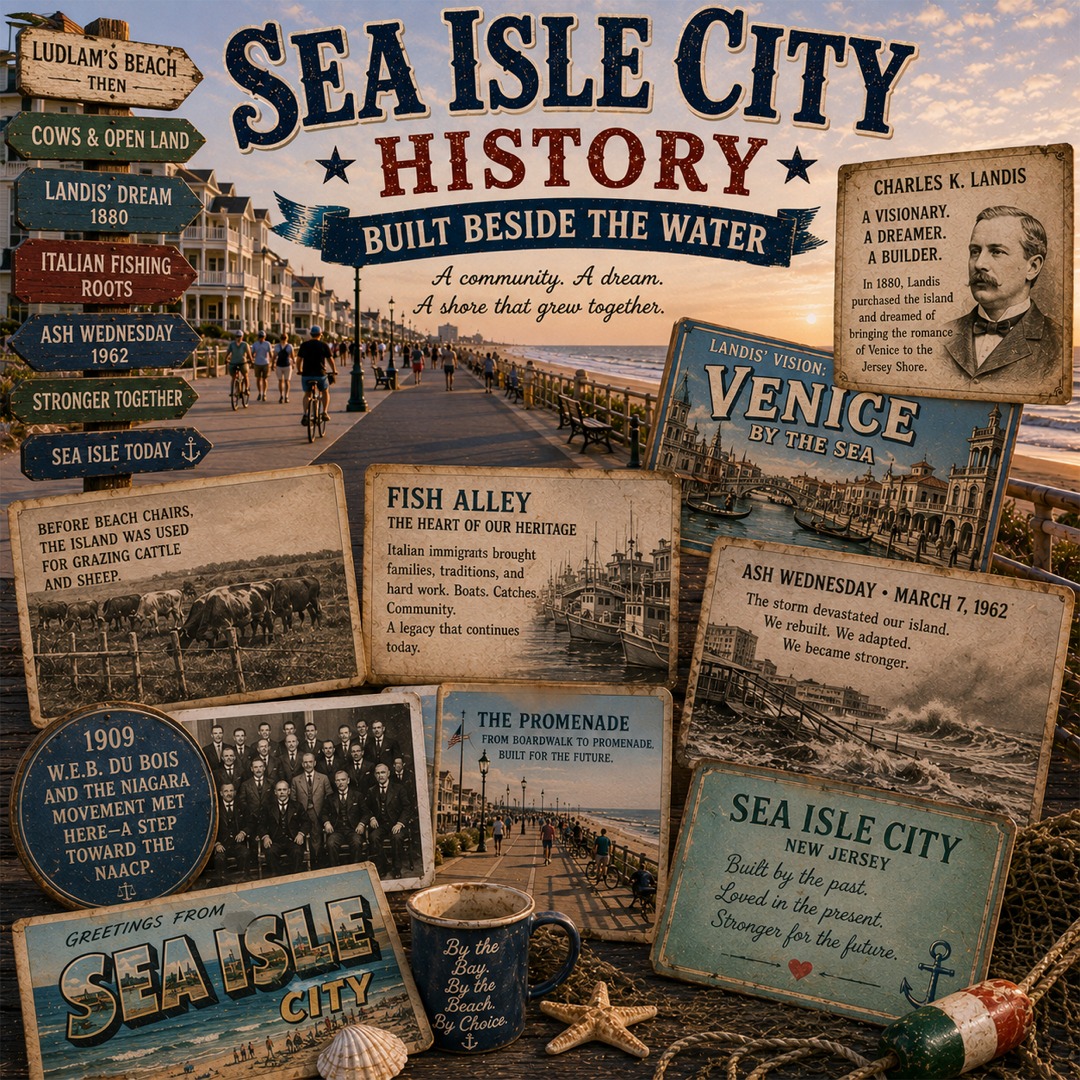
Some beach towns feel discovered.
Sea Isle City feels built.
Not all at once.
Not from a giant blueprint that magically appeared one day.
Built slowly.
Built by dreamers.
Built by fishermen.
Built by families.
Built by people who looked at this little stretch of barrier island and somehow saw more than sand and marshes.
Long before beach chairs and summer rentals showed up, the island was known as Ludlam’s Beach. The Lenni-Lenape visited the area for fishing and gathering quahog shells, while later generations used the island for something many people would never guess.
Cows.
For years the island served largely as grazing land where cattle and sheep wandered freely beneath open skies.
Hard to imagine now, isn’t it?
Today people fight for parking spots where cows once had the place to themselves.
Then came Charles K. Landis.
And Charles Landis had ideas.
Big ideas.
Landis had already founded Vineland, New Jersey, and in 1880 he purchased the island with a dream inspired by Europe. He imagined canals, fountains, waterways, and the romantic atmosphere of Venice transplanted directly onto the Jersey Shore.
Basically he looked at a sandy barrier island and thought:
“Let’s build Italy.”
Now…history gently reports that the whole Venice thing didn’t entirely happen.
But pieces of that dream survived.
Landis laid out roads, designed neighborhoods, and transformed the island into what eventually became Sea Isle City.
Then people started arriving.
A wave of Italian immigrants settled near the back bays, bringing fishing traditions and strong family communities with them. Before long, the area known today as Fish Alley became one of the most important fishing centers on the Jersey Shore.
Boats hauled in flounder.
Crabs.
Clams.
Oysters.
Fresh catches headed toward Philadelphia and New York markets while family businesses began putting down roots that still remain today.
And maybe that’s the cool thing about Sea Isle.
A lot of places grow outward.
Sea Isle grew together.
Even its boardwalk story feels different.
Because today’s Promenade wasn’t always there.
Sea Isle once had a traditional wooden boardwalk, complete with dance halls and gathering spots. But after the devastating Ash Wednesday storm of 1962 tore through the shoreline, much of the town was devastated.
Residents had a choice.
Rebuild exactly what had been there…
Or build something stronger.
So they adapted.
The wooden boardwalk eventually gave way to the asphalt Promenade visitors walk today, creating one of Sea Isle’s most recognizable features.
And then there’s another piece of Sea Isle history that deserves to be remembered.
In 1909, W.E.B. Du Bois brought the Niagara Movement here, the organization that eventually became the foundation for the NAACP. During a time when many communities across America remained heavily segregated, Sea Isle became a welcoming place for Black families and civil rights leaders.
That’s a pretty incredible thing to carry in your story.
Maybe that’s why Sea Isle still feels different.
Because communities leave fingerprints behind.
And if you look closely…
You can still see them beside the water.