Some towns are built on solid ground.
Sea Bright has always lived in the middle of a conversation.
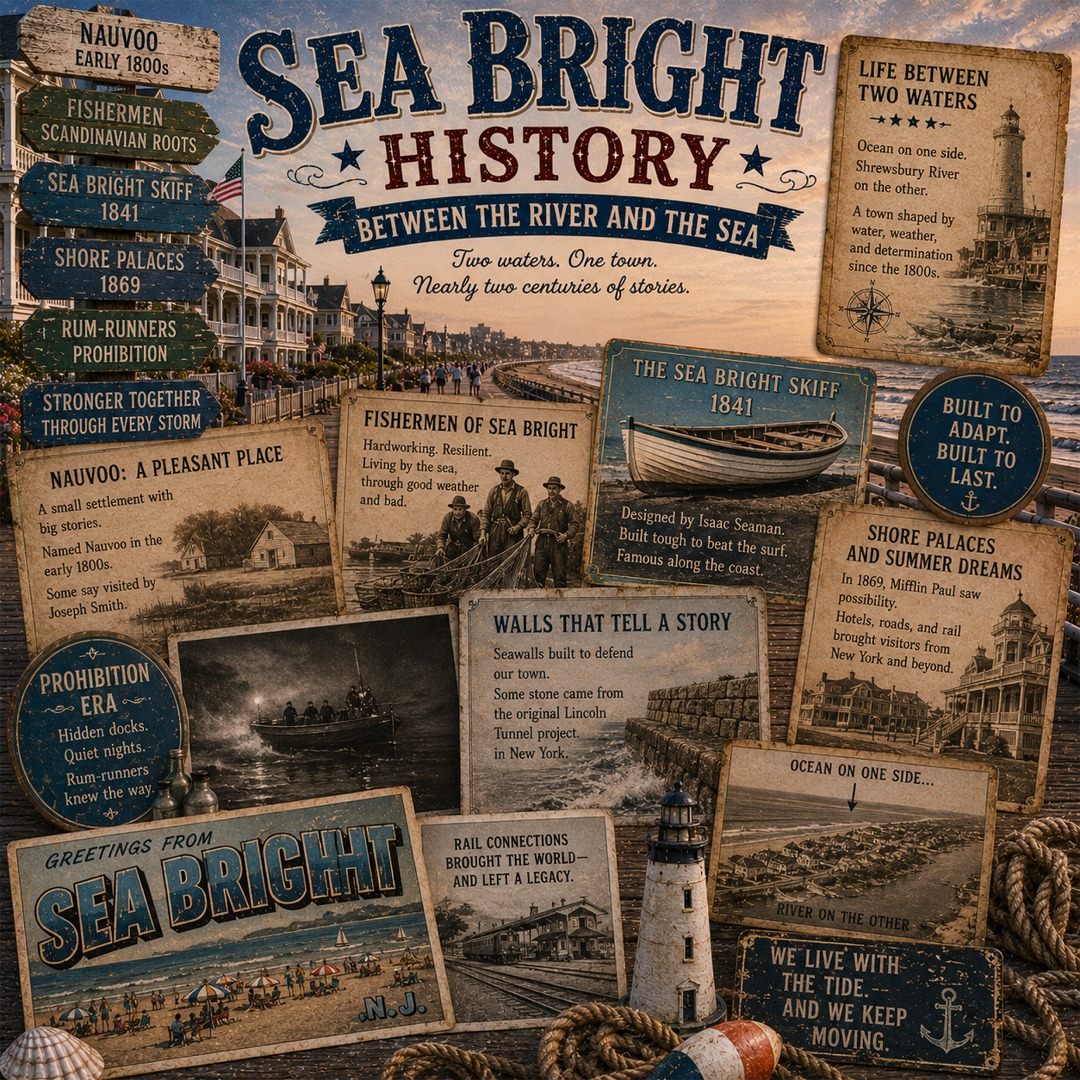
Ocean on one side.
River on the other.
And for nearly two centuries, life here has meant learning how to live between them.
Long before beach clubs, seafood restaurants, and summer visitors arrived, this narrow strip of land looked very different. In the early 1800s it was little more than sand, brush, marsh grass, and a few small structures scattered across a rugged coastline.
The tiny settlement carried a curious name:
Nauvoo.
Depending on which story you believe, it either came from local lore or from a visit by Mormon founder Joseph Smith, using a Hebrew word meaning pleasant place.
Not exactly a bad review.
Back then life here wasn’t glamorous.
The early settlers were fishermen, many of Scandinavian descent, rough-and-ready people who worked directly with the sea. They hauled in fish, dug clams, and built lives where weather reports could make or break a week.
And the ocean could be unforgiving.
Which led to one of Sea Bright’s most fascinating inventions.
In 1841, local boatbuilder Isaac Seaman designed what became known as the Sea Bright Skiff. Built from wood with a flat-bottomed design, these boats could launch directly through rough surf and quickly became famous throughout coastal communities.
Not bad for a little beach town workshop.
Then came transformation.
In 1869, developer Mifflin Paul looked at this narrow barrier strip and saw possibility. Roads appeared. Rail connections followed. Hotels rose along the coastline.
And suddenly wealthy vacationers from New York began arriving.
Massive Victorian “shore palaces” lined Ocean Avenue. Visitors could ride through town with river views on one side and ocean views on the other, creating a shoreline experience that felt unlike anywhere else on the Jersey coast.
But Sea Bright always carried a little outlaw energy too.
During Prohibition, hidden docks and quiet shorelines became useful tools for rum-runners. Boats slipped through fog carrying illegal shipments of whiskey and scotch while smugglers quietly moved cargo toward New York.
History occasionally decides to become a crime movie.
Sea Bright apparently understood the assignment.
And through all of it, there has always been one constant:
The ocean pushes back.
Storms shaped this place repeatedly. Erosion threatened roads and homes. Massive seawalls eventually rose to defend the town, including sections built using stone excavated from the original Lincoln Tunnel project in New York.
Think about that.
Part of New York literally became part of Sea Bright.
Maybe that’s what makes this place feel different.
Sea Bright was never simply built.
It was adjusted.
Rebuilt.
Protected.
Adapted.
Again and again.
Because when you live between two waterways…
You learn how to keep moving with the tide.