Some places keep history in museums.
Sandy Hook hides it in the dunes.
Walk through Sandy Hook today and you might think you’re simply visiting a beautiful beach. Ocean waves roll in. Bicycles pass by. Seagulls drift overhead. Families spread out towels beneath umbrellas.
Looks peaceful enough.
But beneath those peaceful beaches sits layer after layer of stories that feel almost too strange to be real.
Pirates.
Lighthouses.
Revolutionary battles.
Massive disappearing guns.
Missiles.
Entire military towns.
History here doesn’t sit quietly behind glass.
It still feels alive.
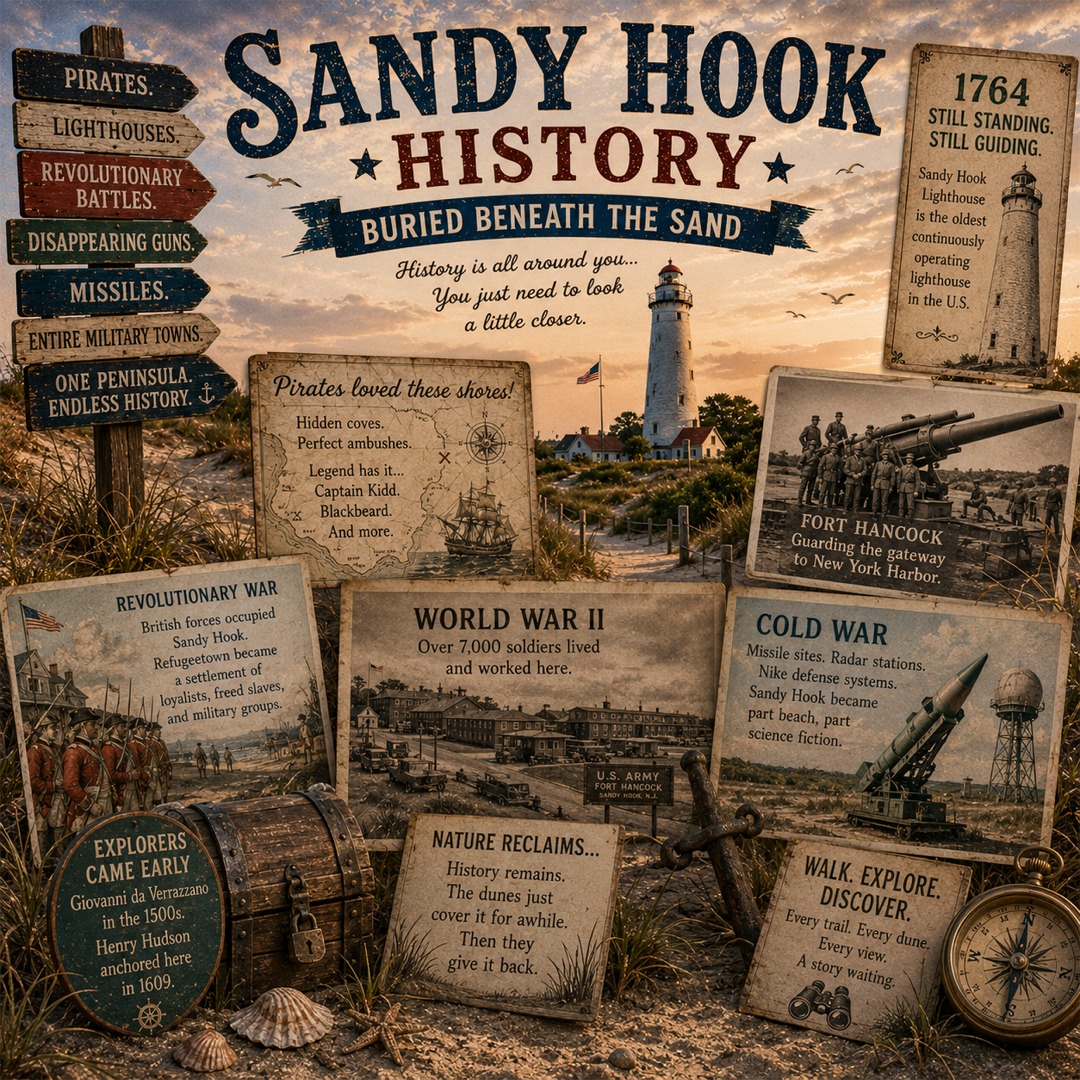
Long before beachgoers arrived, explorers were already navigating these waters. Giovanni da Verrazzano explored the area in the 1500s, and in 1609 Henry Hudson anchored nearby while sailing aboard the Half Moon.
Not long after, Sandy Hook developed a reputation that sounds like it came straight out of a pirate movie.
Because pirates loved this place.
The narrow coves and hidden waterways around Sandy Hook created perfect hiding spots for ships waiting to ambush vessels entering New York Harbor. Legends connect names like Captain Kidd and Blackbeard to these waters, giving the peninsula a little extra pirate seasoning in its history.
Honestly?
You knew Wilson was going to enjoy that part. 🏴☠️
But the most famous figure standing on Sandy Hook isn’t a pirate.
It’s a lighthouse.
Built in 1764, the Sandy Hook Lighthouse still stands today as the oldest continuously operating lighthouse in the United States. Imagine that for a second.
That lighthouse has watched the American Revolution happen.
It watched the Civil War happen.
It watched World Wars happen.
It has basically been standing there saying:
“Yep…still here.”
During the Revolutionary War, British forces occupied the area and established a settlement known as Refugeetown near the lighthouse. Loyalists, former slaves seeking freedom, and military groups moved through the peninsula while conflict surrounded New York Harbor.
Then Sandy Hook transformed again.
After the Civil War, the military realized something important:
If you wanted to defend New York Harbor, Sandy Hook was the front door.
Fort Hancock rose across the peninsula, and eventually enormous gun batteries, underground bunkers, and military facilities appeared among the dunes. During World War II, over 7,000 soldiers lived and worked here.
And then came the Cold War.
Missile systems.
Radar stations.
Nike defense sites.
For a while, Sandy Hook became part beach, part science fiction movie.
Then, almost unbelievably, nature reclaimed much of it.
Today the old batteries sit quietly among grasses and dunes while bicycles and beach chairs roll by overhead.
Maybe that’s what makes Sandy Hook feel different.
History here was never erased.
The sand just drifted over it.
And every now and then…
The dunes give some of it back.